


AI-Powered Defense Against Insider Threats: AhnLab XDR
A recent large-scale personal data breach in Korea triggered by a former employee's misuse of access privileges has once again confirmed that insider threats are a business risk directly tied to corporate trust. It also exposed how traditional perimeter-based security, focused on blocking external attacks, falls short against internal threats that exploit legitimate access privileges. To address this shift, AhnLab offers a proactive, unified security strategy through AhnLab XDR — a platform that detects and blocks insider threats in real time, powered by AI-driven user behavioral analytics.
Insider Threats: Why Traditional Security Falls Short
An insider threat is a security risk where a user with legitimate access privileges abuses organizational assets, whether intentionally or through negligence. What makes insider threats so dangerous is that these actors operate with "legitimate accounts." Because they already hold authenticated IDs and access privileges, traditional security measures like firewalls and antivirus are effectively neutralized. Perimeter-based security, designed to keep "external intruders" out, has clear limitations when it comes to distinguishing threats that are already inside.
The widespread adoption of cloud and remote work has only amplified these limitations. As data access has shifted from a perimeter-centric to a user-identity-centric model, a single unrevoked account from a departing employee, or a contractor's access privileges left active after contract termination, can become a serious security vulnerability on its own. The key to insider threat defense is no longer questioning "who is an insider," but building a framework that treats every account as a potential risk and continuously validates the behavior of every user — even those with legitimate access privileges.
AhnLab XDR: Turning Alert Noise into Clear Priorities
Amid this shifting landscape, XDR (eXtended Detection & Response) has emerged as a security platform drawing significant attention. As the threat surface has expanded across endpoints, networks, cloud, and beyond, enterprises have deployed a wide range of security solutions to defend each domain. According to Gartner, as of 2024, enterprises operate an average of 45 security solutions, with some running as many as 130. But as the number of solutions has grown, so has the volume of detection events and alerts — exponentially. Among thousands of alerts, identifying which threats demand immediate attention has become increasingly difficult.
AhnLab XDR is built to solve this problem. Its core philosophy is not to detect and display as much as possible, but to provide response priorities that reduce organizational risk and strengthen security posture. To achieve this, AhnLab XDR aggregates and normalizes data generated across security solutions, analyzes correlations between events to identify risks, and reconstructs multiple events into a single incident flow. Behavior that appears normal when viewed through a single solution's alert can reveal a hidden threat pattern when connected within the full context.
Risks identified this way are then quantified through an advanced calculation model that produces a Risk Score. Asset criticality, event characteristics, probability of occurrence, and weighting factors are comprehensively calculated to generate a score from 0 to 100. Even when two risks share the same probability, different scores are assigned based on asset criticality. With this score, security teams can intuitively grasp which risks pose the greatest impact to the organization right now and respond accordingly. This is the decisive difference between a simple detection solution and an XDR platform.
Detecting Insider Data Leaks with AI-Driven Behavioral Patterns
What gives AhnLab XDR its strength in defending against insider threats is its AI-driven behavioral analytics capability. Most insider threats leave no clear malware or intrusion traces. Because they rely on legitimate access privileges, individual events alone make it difficult to determine whether anomalous activity is occurring. Detecting insider threats therefore requires analyzing user behavioral patterns rather than isolated events.
Through AI-driven behavioral analytics, AhnLab XDR learns the baseline activity patterns of users and assets, and uses this baseline to detect behavior that falls outside the normal range. Consider an employee who typically logs off at 6 p.m. and downloads fewer than 10 files a day. One night at 9 p.m., that employee connects via VPN from a different region, downloads a large volume of project files, and attempts to send them to an external email address. Viewed in isolation, each action falls within the normal range. But AhnLab XDR connects these deviations from the baseline into a single flow, identifies the activity as a data exfiltration attempt, and responds accordingly. The next morning, security teams can review the full sequence of events and automated response history at a glance on the AhnLab XDR dashboard.
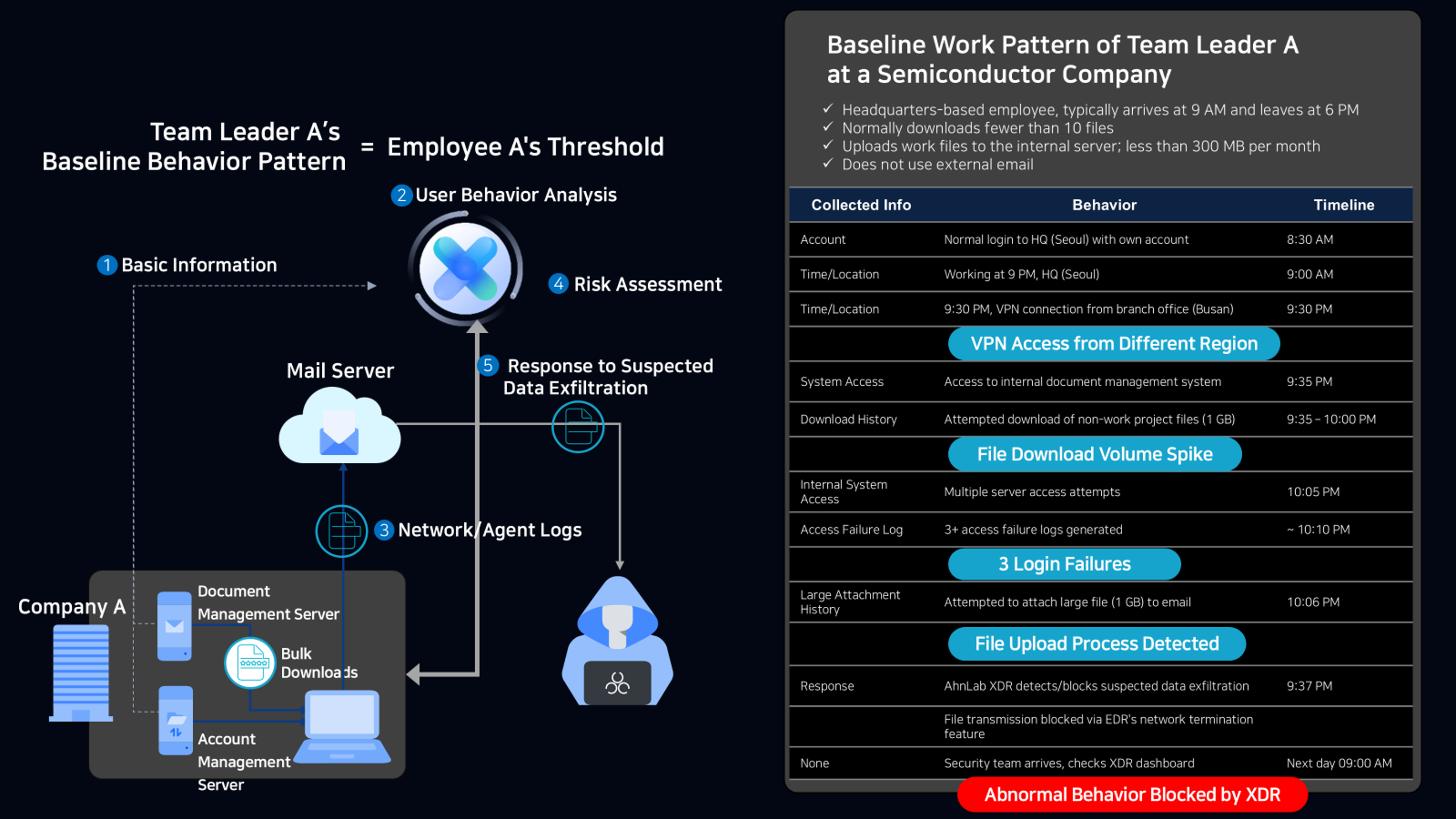 Image 1. AhnLab XDR Insider Threat Detection Scenario
The Key to Insider Threat Defense: Proactive Security
The lessons from the recent string of insider threat incidents are clear. Insider threats are now a business risk directly tied to corporate trust. Yet by their very nature, the damage is often recognized only after an incident has already occurred. The key to insider threat defense lies in building a proactive security framework that can detect anomalies early and respond before damage is done.
What enterprises need now is not yet another point solution, but a strategic security framework that can comprehensively identify organization-wide risks and manage them by priority. By detecting anomalous insider behavior in real time and responding automatically through AI-driven behavioral analytics, AhnLab XDR offers a practical solution that shifts insider threat defense away from reactive response toward an AI-driven, proactive defense framework.