


How Agentic AI Is Reshaping the Role of Security Admins
What if AI could handle part of your job on the way to work this morning?
Some people would find that convenient, while others might feel anxious that AI could eventually replace their jobs.
What matters is that this is no longer a hypothetical scenario. AI is rapidly evolving beyond simply providing answers and is increasingly becoming capable of performing tasks alongside humans. At the center of this transformation is agentic AI.
This article explores what agentic AI is, how it differs from past AI, the opportunities and risks it presents for security professionals, and how organizations should prepare for the future.
What Is Agentic AI?
The evolution of AI can broadly be divided into three stages:
- Predictive AI: Analyzes historical data to classify or predict outcomes.
- Generative AI: Generates answers, text, code, and images in response to prompts.
- Agentic AI: Goes beyond generating answers by receiving requests, creating plans, and executing tasks autonomously.
In simple terms, AI is evolving from “informing” to “performing.”
The core characteristics of agentic AI include:
- Autonomous: Makes decisions without constantly waiting for human instructions.
- Goal-driven: Performs multi-step tasks to achieve objectives.
- Tool use: Actively interacts with internal/external systems
- Memory: Retains previous results and uses them for future actions.
Agentic AI is therefore not simple automation; it is a goal-oriented autonomous execution.
How Is Agentic AI Different?
The biggest difference between generative AI and agentic AI is that the former is reactive, while the latter is action-oriented. Generative AI responds to questions, and humans remain at the center of the workflow. Agentic AI, on the other hand, receives a request, determines the necessary steps, uses appropriate tools, and produces results autonomously.
From a cybersecurity perspective, the transition is from “Summarize this log” to “Identify suspicious activity, gather relevant information, isolate affected systems, create a ticket, and generate a report.”
Security operations are shifting from being human-centered to AI-assisted and increasingly AI-driven.
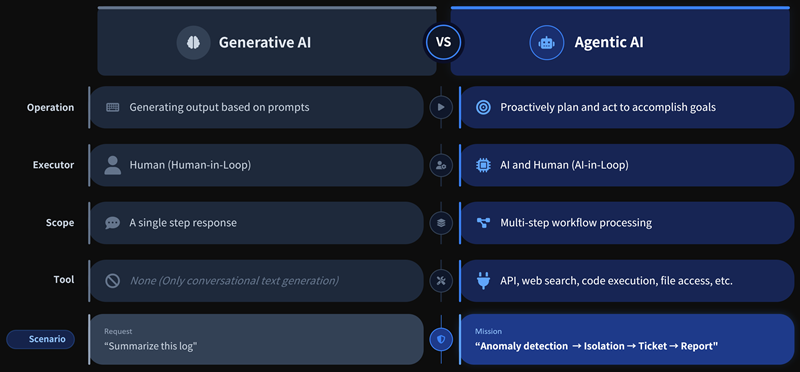
Figure 1. Generative AI vs. Agentic AI
Recently, interest in agentic AI has surged because three key areas have matured:
- LLM reasoning capabilities: Now supports complex multi-step problem solving.
- Agent frameworks and protocols: Improves tool integration and execution.
- API-centric enterprise: Allows security tools, ticketing systems, cloud services, and authentication platforms to be connected.
The technology and infrastructure are now ready, and market demand is growing rapidly.
According to Gartner, 60% of organizations are expected to provide personalized one-to-one customer interactions through AI agents. AI is no longer merely an assistant - it is becoming an operational component of organizations.
How Cybersecurity Roles Will Change
For cybersecurity teams, there are four major trends.
- Agentic AI oversight: Invisible AI agents introduce new attack surfaces.
- IAM for AI agents: AI agents must be managed as operational identities.
- AI-driven SOC: AI will increasingly handle repetitive security analysis tasks.
- Preemptive security: Security shifts from post-incident response to early prevention.
Historically, security admins primarily operated tools and manually managed them, responding to alerts. In the future, their role will increasingly become that of an orchestrator - designing AI agents, defining policies, approving exceptions, validating outcomes, and overseeing autonomous systems. In simple terms, AI is not replacing humans; it is changing their responsibilities.
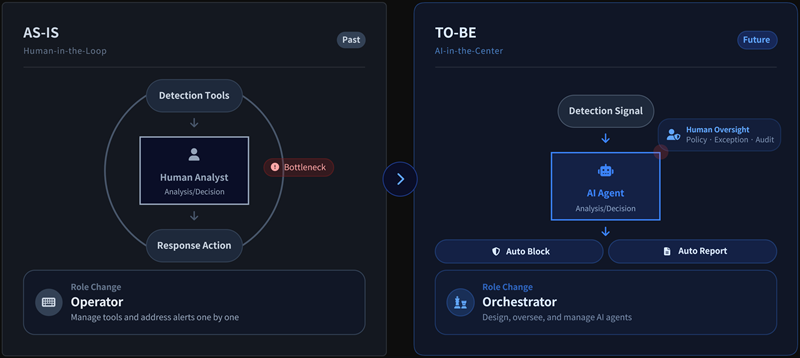
Figure 2. Agentic AI security model
Let’s explore expected changes in each cybersecurity domain.
#1. Endpoint Security
The potential use cases of AI agents in endpoint security are quite obvious.
- Autonomous threat detection and isolation: When suspicious ransomware activity is detected, the AI agent can immediately isolate the affected endpoint, extract related Indicators of Compromise (IoCs), and deploy blocking policies across other endpoints.
- Automated vulnerability prioritization: Instead of relying solely on CVE scores, the AI agent can assess actual risk based on factors such as exposure level, asset criticality, and the likelihood of exploitation, then dynamically adjust patching priorities.
- Automated forensic data collection and reporting: The AI agent can automatically gather forensic artifacts, including memory dumps, process trees, and network connection histories, and then draft investigation reports.
The primary benefits are reduced Mean Time to Respond (MTTR) and more efficient use of threat analysis resources.
#2. Network Security
Key agentic AI use cases in network security include:
- Autonomous segmentation and policy optimization: Continuously analyzes traffic patterns and optimizes security policies accordingly.
- Dynamic zero trust policy enforcement: Enforces zero trust policies dynamically based on context, rather than relying on static rules.
- Autonomous DDoS and C2 blocking: Automatically blocks threats that require rapid response, such as DDoS attacks or C2 (Command and Control) communications.
- Autonomous remediation of misconfigurations: Automatically detects and corrects configuration errors, such as misconfigured security groups or publicly exposed storage in cloud environments.
After all, AI becomes a critical driver of policy automation and response speed.
#3. SOC
Modern security operations are increasingly evolving into multi-agent systems:
- Detection agent: Identifies events and anomalies
- Threat intelligence agent: Provides reputation and attacker context
- Forensics agent: Collects evidence automatically
- Response agent: Performs containment and blocking actions
- Reporting agent: Creates tickets and reports
Recently, this style of AI-agent-based security operations has been formalized under the concept of an Agentic SOC. The key advantages of this model are speed and collaboration. It helps eliminate the bottlenecks that occur when a human analyst must perform every step of the process sequentially.
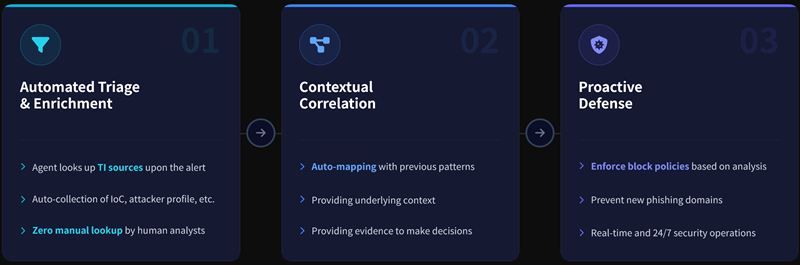
Figure 3. Agentic SOC Workflow
For many security professionals, AI-agent-driven security operations will likely be the first area where the impact of agentic AI becomes noticeable in day-to-day work. Traditionally, when an alert was generated, analysts had to manually perform reputation lookups, review historical records, examine similar incidents, assess the impact, and determine appropriate response actions.
However, when Agentic AI is integrated into security operations, it can analyze and consolidate the information required for decision-making and present it in an actionable format. As a result, security professionals can spend less time gathering and organizing information and focus more on making high-value decisions.
Risks Introduced by Agentic AI
Agentic AI provides tremendous opportunities for innovation to enterprises and security professionals. The challenge is that attackers have access to the same opportunities.
AI agents are highly attractive tools for attackers as well. They can dramatically increase the speed, scale, and sophistication of attacks. The ways in which attackers can leverage AI agents include the following:
- AI-powered autonomous attack campaigns: Using AI agents to autonomously execute the entire attack chain, from vulnerability scanning and initial compromise to lateral movement and data exfiltration.
- Advanced spear-phishing: Learning publicly available information about targets to generate highly customized messages at scale, while operating as a “conversational phishing agent” that responds to victims in real time.
- Vulnerability weaponization: AI agents can immediately analyze publicly disclosed CVE information and generate exploit code, reducing the “golden time” between patch release and attack execution.
In addition to using AI to enhance attacks, organizations must also consider attacks directed at the AI agents they use. Related threats can be categorized into five areas:
- Prompt injection: Injecting malicious prompts to manipulate the LLM’s original instructions and induce unintended behavior.
- Agent hijacking: Stealing tokens or credentials to impersonate AI agents and gain control of systems.
- Tool poisoning: Manipulating execution by compromising external tools or plugins used by AI agents.
- Memory poisoning: Corrupting long-term memory sources such as databases to undermine decision-making logic.
- Excessive permissions: Granting agents more privileges than necessary, thereby amplifying the impact of a single compromise.
In summary, while it is important to successfully deploy and utilize AI agents, the primary challenge is to first establish a structure that controls the permissions and execution paths associated with AI.
Therefore, as organizations enter the Agentic AI era, they need to prepare for AI security and governance. This concept has recently gained significant attention in the cybersecurity industry.
- Agent inventory: Ensure visibility into all AI agents operating within the organization (including SaaS) and clearly define their owners and managers.
- Least privilege: Configure read-only access by default, restrict network segments accessible to agents, and separate permissions on a per-task basis.
- Human-in-the-Loop policies: Define which actions can be automated and which require approval, and establish a “kill switch” capable of immediately stopping agents in the event of malfunction.
- Machine identity: Treat agents as machine actors and operate dedicated credentials and audit logging systems for them.
Agentic AI Security Transformation with AhnLab AI PLUS
AhnLab is supporting customers in their AI security transformation through our agentic AI security platform, AhnLab AI PLUS. Built on our 30 years of accumulated threat intelligence, incident response experience, and extensive security data, AhnLab AI PLUS empowers our platform to deliver accelerated AI security capabilities.
AhnLab AI PLUS aims to:
- Enhance intelligent detection and analysis through AI agents
- Expand AI-driven operations across various products and services
- Provide advanced AI services based on proprietary data collection and training
As such, we are driving AI-powered intelligence across entire products, platforms, and services.
As for the architecture of AhnLab AI PLUS, extensive cybersecurity data are centralized into a data lake, where data processing and model training are performed to build security-specialized LLMs and knowledge databases. The platform provides LLM and knowledge retrieval capabilities to the application layer through API services. In addition, we applied guardrails to ensure data and model reliability, risk management, and security to minimize potential risks.
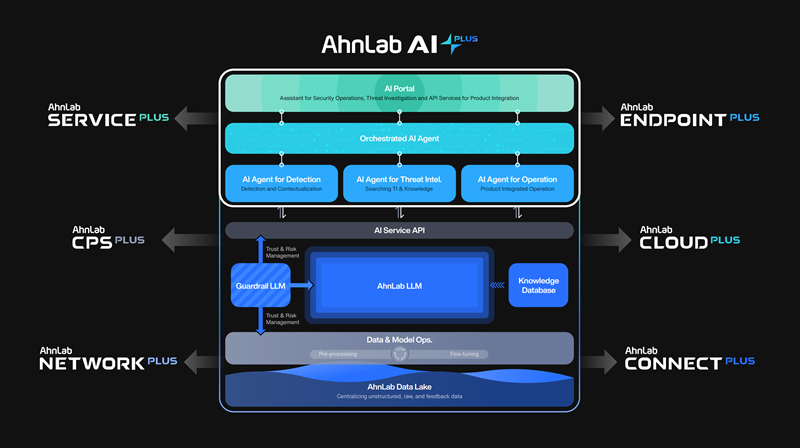
Figure 4. AhnLab AI PLUS architecture
Consequently, we are running an AI agent for detection, threat intelligence, and security operations that collaborate to solve cybersecurity challenges. The orchestration agent coordinates the activities of these agents and manages the entire workflow.
For example, let’s assume that a user uploads event logs and requests analysis and impact assessment. Then, the orchestration agent assigns tasks to the relevant AI agents. These agents perform log analysis, structured summary, critical file and URL analysis, and risk assessment. In the end, it consolidates all the results to provide final conclusions with recommended response action (Watch demo of agents in action).
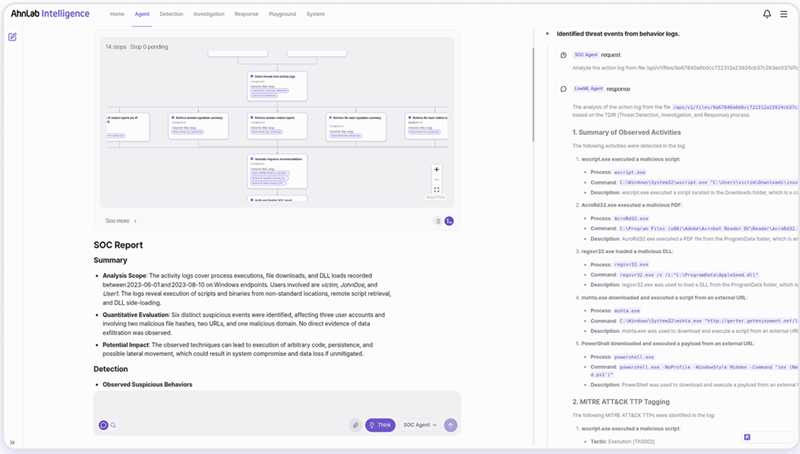
Figure 5. AI agents in action
AhnLab provides not only agentic AI security but also AI security & governance capabilities. A prompt security solution, SecureBridge, detects and blocks confidential and sensitive information in prompts to prevent it from being leaked or learned by LLMs. It forces only secure prompts to be transmitted, enabling organizations to use AI safely without concerns about data leakage.
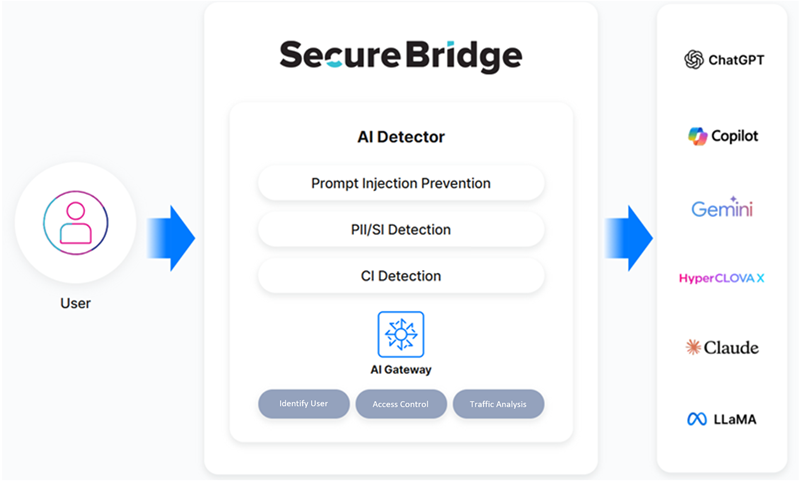
Figure 6. How SecureBrige works
FAQ: AhnLab AI PLUS
#1. How is it different from AhnLab’s previous AI?
Our existing AI technologies have primarily been applied to threat detection to improve speed and accuracy. AhnLab AI PLUS not only enhances detections but also enables AI agents to autonomously collaborate on security challenges and support human decision-making. From a security professional’s perspective, this makes it easier to understand security events or challenges more intuitively and identify threats more quickly. In addition, the accuracy of security operations and the speed of response are improved, enabling efficient responses across a variety of attack scenarios.
#2. How is it applied to security solutions?
AhnLab has begun deploying AhnLab AI PLUS by integrating its AI security assistant, Annie, into AhnLab XDR. The XDR’s UI provides a conversational AI security assistant equipped with various capabilities that support security operations, including:
- Real-time threat detection
- Response recommendations (playbooks)
- Suggested follow-up questions
Through these features, customers can easily understand their security status and establish faster and more systematic response processes.
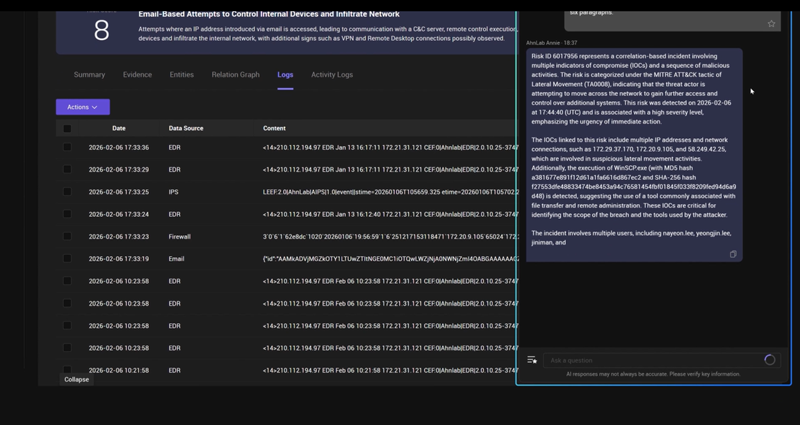
Figure 7. AI security assistant integrated into AhnLab XDR
Going forward, we plan to deploy AI agents across our products and platforms.
#3. Are there concerns about data leakage during model training?
First of all, AhnLab AI PLUS does not collect or utilize customer data for training. Instead, it leverages our threat analysis and incident response data, along with threat intelligence from AhnLab TIP (threat intelligence platform) and AhnLab Smart Defense (engine) infrastructures. These enable our AI model to be trained with extensive information, including files, URLs, IP addresses, and behavioral patterns, ultimately improving AI service quality.
Conclusion
In a single sentence, agentic AI can be defined as: “an autonomous AI system that plans, takes actions using tools, and achieves goals on its own.” For security professionals, it represents both a powerful automation opportunity and a new attack surface. While it is important to use AI agents effectively, organizations must also establish mechanisms to control and validate their actions.
Agentic AI is no longer a distant future technology. It is more of a present reality that is already spreading. The first question readers should consider after reading this article is:
“How will our organization use AI agents, and are we prepared to use them effectively and securely?”
If security professionals truly understand the context of this question, they will keep staying successful in the rapidly changing AI era.
- AhnLab