AI vs. AI: Why It Takes AI Security to Stop AI Attacks
As attackers weaponize AI, defense must also match the speed of AI
Next-generation AI such as Claude Mythos has recently drawn attention for its potential use in cyberattacks—from vulnerability discovery to attack scenario generation—fueling growing interest in how AI will reshape the way attacks are carried out.
Generative AI transformed the way we work, and we are now moving rapidly into the era of agentic AI, which plans and executes tasks autonomously. This shift is reshaping not only enterprise productivity but also the mechanics of cyberattacks and security operations.
Traditionally, cyberattacks were executed step by step, with attackers manually finding vulnerabilities and writing attack code. But as AI automates both attack preparation and execution, attacks can now be launched faster, against more targets, and far more repeatedly.
This creates a new challenge for defenders. Countering AI-powered attacks with conventional, human-driven security operations alone falls short in both speed and scale. Enterprises must stop treating AI as merely something to protect or control, and start using it as a core technology to strengthen their security operations.
In the end, security competitiveness in the AI era comes down to one thing: how quickly new threats can be detected, analyzed, and responded to.
How AI Has Changed Cyberattacks
What is an AI-powered cyberattack?
An AI-powered cyberattack uses artificial intelligence to automate the stages of a cyberattack—vulnerability discovery, attack scenario generation, phishing, malware creation, and attack execution. Its defining trait is that AI doesn't invent new attack techniques; it enables existing ones to be carried out faster and more repeatedly.
From Generative AI to Agentic AI
Generative AI answers questions and produces text, code, and images. Agentic AI, by contrast, can plan on its own toward a given goal and complete multi-step tasks using the tools it needs. In security operations, for instance, it goes beyond merely summarizing logs to run an entire sequence as a single flow—gathering relevant information, analyzing threats, and then recommending response measures. In short, AI is evolving from "a tool that generates answers" into "an agent that gets work done"—and the same shift is playing out in cyberattacks.
Automation and Speed Are What Define AI Attacks
The rise of AI hasn't changed the fundamentals of cyberattacks. Techniques like vulnerability exploitation, malware execution, account takeover, privilege escalation, and lateral movement are still extensions of established methods. What's changed is how attacks are carried out. AI can rapidly analyze vast amounts of data, automate repetitive tasks, and decide its next move based on the results. Attackers use this to find vulnerabilities faster, generate a wider range of attack scenarios, and run the same attack at scale.
In the end, the essence of AI-powered attacks lies not in a new technique, but in the automation and acceleration of existing ones.
How AI Makes Attacks More Sophisticated
AI can dramatically increase both the efficiency and the scale of attacks. The key changes are as follows.
① Automating vulnerability discovery and attack preparation
AI analyzes publicly available vulnerability data and technical documentation to rapidly compile information it can use in an attack. As preparation time shrinks, so does the window between a new vulnerability's disclosure and a real-world attack.
② Running large-scale attacks repeatedly
AI can repeat the same task without rest. It can pursue multiple attack strategies at once and, learning from failed attempts, apply new methods to keep the attack going.
③ Sharpening tailored attacks
AI can draw on publicly available information to craft phishing messages aimed at a specific organization or user, or to build attack scenarios suited to the situation. Down the road, it could evolve to sustain a conversation based on how the target responds.
AI Also Becomes a New Attack Surface
AI automates attacks, but it also becomes a new target of them.
Once enterprises start using AI agents in their operations, what systems an AI accesses, what privileges it holds, and what tasks it performs all become new items to manage from a security standpoint. An attacker might, for example, feed an AI malicious instructions to trigger unintended actions, or hijack an AI agent's privileges to access systems while posing as a legitimate user.
Going forward, then, enterprises need not only ways to leverage AI, but also a security framework for operating AI itself safely.
Why It Takes AI Security to Counter AI Attacks
What is AI security?
AI security is a security framework that protects AI models, training data, inputs and outputs, and the systems AI connects to from attacks and misuse. While conventional security focused on protecting networks, endpoints, servers, and user accounts, AI security broadens that focus to include models, data, and the AI's decision-making process.
The Limits of Human-Centered Security Operations
Conventional security operations have relied on people to review security events, analyze whether they pose a threat, and then respond.
But as AI-powered attacks drive up the speed and scale of attacks, the volume of security events that people must handle rises with them.
Security teams have to sift through countless logs, gather information from multiple security systems, judge whether an attack is underway, and set response priorities. It's a process that demands deep expertise—and considerable time and effort.
When attacks are automated by AI but defense stays at human speed, the gap between the two can only keep widening.
AI Security Is a New Operating Model
AI security isn't about adding generative AI features to existing security products. The essence is using AI to boost the speed and efficiency of security operations as a whole. AI can analyze massive volumes of security data, establish an attack's context by connecting it with threat intelligence, and propose response priorities. With AI handling repetitive analysis and investigation, security experts can concentrate on the judgment calls and strategy that matter most.
In this sense, AI security isn't a single feature—it's a technology that transforms the security operations model itself.
From Detection to AI-Powered Security Operations
Security is shifting from simply detecting known threats to identifying and responding to new ones as fast as possible. Meeting that bar means unifying data across endpoint, network, cloud, CPS, and other domains, and letting AI analyze it to rapidly trace an attack's path and scope of impact. It also means putting a structure in place where security experts validate AI's analysis and recommended actions before making the final decision.
In the end, security in the AI era is advancing toward pairing the strengths of people and AI to raise operational efficiency and response speed. In an age where attackers use AI, defenders have to use it as well. AI security is no longer an optional capability—it's becoming a new way to operate security.
How AI Security Operations Are Changing
AI-powered security operations aren't merely a matter of faster analysis. Their real value is in reshaping how security is operated—moving from a human-centered approach to one built on collaboration between AI and experts.
What is an AI SOC (AI Security Operations Center)?
An AI SOC is a next-generation security operations model that uses AI to support the full scope of operations—detection, analysis, investigation, and response.
It's built around a human-in-the-loop structure, where AI handles repetitive analysis and security experts own the final judgment and decisions.
How Agentic AI Changes Security Operations
Conventional AI stayed in a support role—answering analysts' questions or summarizing logs.
Agentic AI goes further: it can plan and execute, on its own, the tasks needed to reach a given goal. In security operations, it's evolving to run an entire sequence as a single flow—detecting a threat, collecting and analyzing the related information, and then recommending how to respond. When a new security event occurs, for instance, AI can pull the relevant logs and threat information, analyze the attack's flow and scope of impact, and propose response priorities. Analysts then review AI's findings and make the final response call. In this way, AI takes on repetitive operational work while security experts shift toward focusing on judgment and decision-making.
What is Agentic AI?
Agentic AI is AI that, rather than just generating answers in response to a user's instructions, sets its own plans and uses a range of tools to perform tasks in order to reach a goal. In security, it is evolving into a technology that carries out detection, analysis, investigation, and response as one continuous flow.
Multiple AI Agents Operate Security Together
Going forward, security operations are expected to evolve toward a model where multiple AI agents—each owning a different role—collaborate, rather than one AI doing all the work. One agent might analyze security events, another check threat intelligence, and another recommend response measures. Each agent's output feeds into a single operational flow, enabling faster and more consistent security response.
The point of this structure isn't to replace people's work. By offloading repetitive tasks to AI, it frees security experts to focus on the higher-stakes work of judgment and strategy.
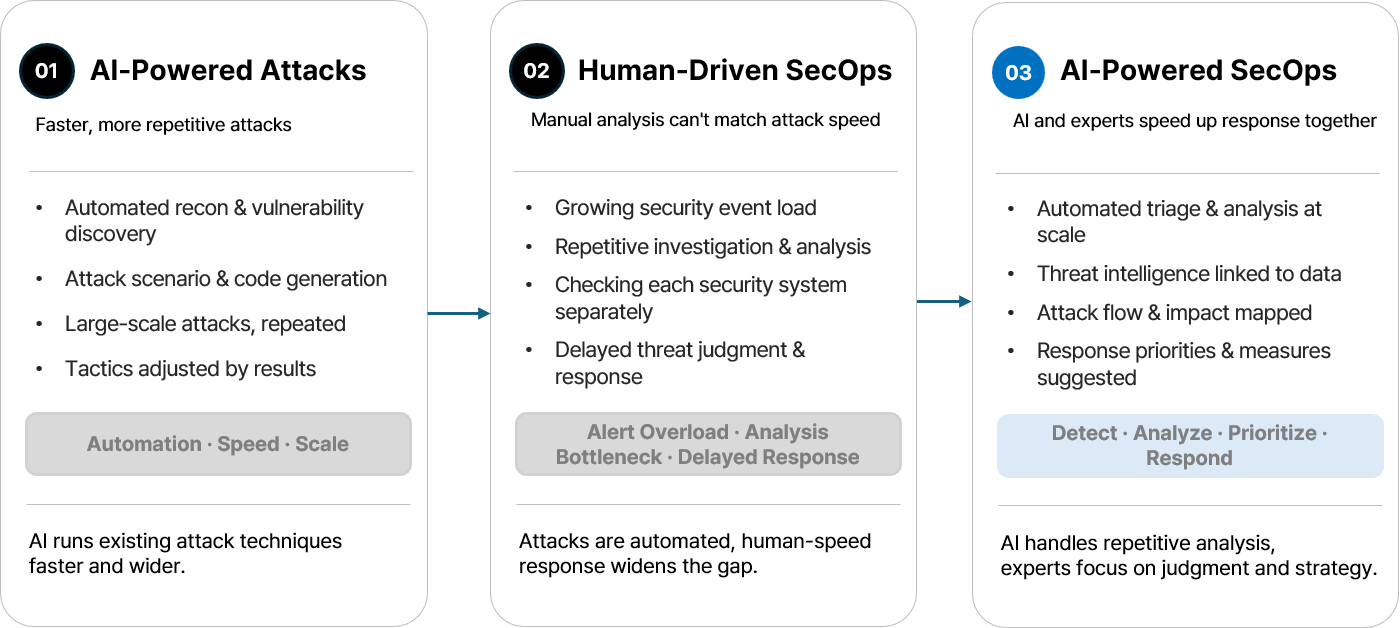
Image 1. AI attacks and AI security at a glance: if attacks evolve at AI speed, defense must match that speed.
Collaboration Between AI and Experts Is Key
AI is advancing fast, but ultimate responsibility for security operations still rests with people.
Real-world response has to weigh more than technical risk—business impact, system criticality, regulation, and compliance all factor in. That kind of judgment is hard to make with AI alone.
So the AI security of the future will hinge on a human-in-the-loop structure: AI supports analysis and response, and security experts verify it and make the final call.
AI's role isn't to replace people—it's to help them judge faster and more accurately.
How AhnLab Is Preparing for the AI Attack Era
AhnLab sees AI not as one more feature added to existing products, but as a core technology that connects and advances security operations as a whole. With that in mind, it is developing an AI-powered security operations framework built around its own AI platform, AhnLab AI PLUS.
AhnLab AI PLUS: An AI Platform for Security Operations
AhnLab AI PLUS isn't a standalone security product. It's a unified AI platform that connects AhnLab's various security products and services—endpoint, network, cloud, CPS, and more—through AI, bringing intelligence across the whole of security operations.
AhnLab is structuring over 30 years of accumulated malware analysis data, threat intelligence, and incident response experience so that AI can draw on it. On this basis, AI analyzes security events, understands the context behind threats, and proposes how to respond. The essence of AhnLab AI PLUS, then, lies not simply in adopting the latest AI models, but in enabling AI to make effective use of the security data AhnLab has accumulated over the years.
How AI Supports Security Operations
In AhnLab AI PLUS, a single AI doesn't carry out every task.
AI agents responsible for different roles—security event analysis, threat intelligence, response support, and more—collaborate to form one security operations flow.
For example, when a new security event occurs, AI can support the following process:
- Event and log analysis
- Checking related threat intelligence
- Analyzing the attack flow and scope of impact
- Risk assessment
- Recommending response priorities and measures
Based on these findings, security experts can more quickly decide whether a response is required.
Extending AhnLab AI PLUS Across the Entire Portfolio
AhnLab AI PLUS isn't AI applied to one product—it's a unified AI platform that connects AI capabilities across AhnLab's various security products and services.
Today, AI capabilities are being expanded across multiple products to enable AI-powered security operations, with two notable examples: AhnLab XDR's AI security assistant, "Annie," and AhnLab EDR's "AI Insight."
Annie is a conversational AI security assistant that lets security teams query threat information in natural language and quickly pull up related events and analysis. By cutting the time spent on repetitive lookups and analysis, it frees them to focus more on threat analysis and response.
AI Insight is an AI-powered analysis feature that comprehensively analyzes events detected by AhnLab EDR and delivers—as a single analysis report—the attack intent, threat context, MITRE ATT&CK-based TTPs, threat intelligence, recommended response direction, and more. With it, security teams can quickly grasp what complex events mean and prioritize their response more efficiently.
In this way, AhnLab isn't confining AI capabilities to specific products; it's continuously extending them across its range of security products and services, all centered on AhnLab AI PLUS, to advance its AI-powered security operations framework.
AhnLab's AI Edge Comes from Security Domain Expertise
The performance of AI security isn't determined by the AI model alone. How deeply it understands the real security environment—its domain-specific data and operational experience—is what drives the AI's accuracy and usefulness.
Building on more than 30 years of accumulated security expertise and threat analysis experience, AhnLab is advancing a domain-specific AI purpose-built for security. The core of AhnLab's AI strategy is enabling AI to understand the context of real security threats and carry out more accurate detection, analysis, and response. This edge rests on four foundations.
① Security Domain Expertise: AhnLab draws on more than 30 years of malware analysis data, incident response experience, and security operations know-how as the foundation for AI training and analysis. This lets AI move beyond merely analyzing data to understand the context of the real security environment and make more sophisticated judgments.
What are domain-specific AI and security domain expertise?
Domain-specific AI is AI trained or optimized on the data and specialized knowledge a particular industry or field requires. Because it understands that field's terminology, business rules, data structures, and operational context, it can deliver more accurate and practical results than general-purpose AI.
Security domain expertise is the specialized knowledge and data built up in cybersecurity—malware analysis, threat intelligence, incident response, security operations experience, and more. AhnLab combines this expertise with AI to advance a platform that understands the context of real threats and supports more accurate detection, analysis, and response.
② Threat Intelligence: The threat intelligence AhnLab has continuously accumulated is a core asset that helps AI analyze attack techniques, threat behavior, and risk levels more accurately, and prioritize the response.
③ Unified Security Platform: By connecting data from across security domains—endpoint, network, cloud, CPS, and more—into a single operational flow, it gives AI an environment to analyze not just individual events but the full flow and scope of impact of an attack.
④ Trustworthy AI Operations: The wider AI's use becomes, the more accuracy and reliability matter. AhnLab focuses on building a trustworthy AI-powered security operations environment—raising AI's autonomy while applying guardrails and an expert verification framework.
Ultimately, the core of AhnLab's AI advantage isn't adopting the latest AI models. What sets AhnLab apart is combining security domain expertise, threat intelligence, a unified security platform, and a trustworthy AI operations framework so that AI can understand and put to use the real security environment.
A New Kind of Security Competitiveness Is Emerging in the AI Era
AI is rapidly reshaping the speed and scale of cyberattacks. Attacks will only grow more automated and intelligent, and security operations will inevitably have to evolve in response.
Enterprises must now see AI not merely as something to protect or control, but as a core technology for strengthening their security operations. In an era where attackers leverage AI, defenders must use AI too—to speed up detection, analysis, and response.
AI, of course, doesn't replace security experts. Its strength is in rapidly analyzing vast amounts of data and taking on repetitive work, while the final judgment and decisions remain the domain of security experts. Security operations are likely to move toward a human-in-the-loop model that combines the respective strengths of AI and people.
In step with this shift, AhnLab is advancing AI not as a standalone feature but as a platform technology that connects security operations as a whole. Centered on AhnLab AI PLUS, it continues its R&D—uniting security domain expertise, threat intelligence, and a unified security platform—so that AI delivers real-world value in everyday security operations.
In the end, security competitiveness in the AI era lies in considering both how safely AI is managed and how effectively it is used. Through an agentic AI-based security operations environment that combines AI with security expertise, AhnLab will continue to advance its AI security capabilities so enterprises can respond to threats faster and more accurately.
See AhnLab's AI-Powered Security in Action
In the era of AI-powered attacks, understanding how AI-powered security works is crucial. Watch our demo videos to see AhnLab AI PLUS and its diverse AI-powered security capabilities firsthand.
[Demo] AhnLab AI PLUS – AI Agents Analyzing Event and Impact
[Demo] AhnLab XDR – Addressing the Real Cyber-Attack Scenario
[Demo] AhnLab TIP – AI-Assisted Threat Actor Hunting – Lazarus
FAQ: Key Questions About AI Attacks and AI Security
Q1. How do traditional cyberattacks and AI attacks differ?
The biggest difference is automation and speed. Traditional attacks required the attacker to carry out each stage by hand, whereas AI-powered attacks can automate multiple tasks and repeat them. This lets them target more systems and vulnerabilities in the same span of time.
Q2. What's the difference between generative AI and agentic AI?
Generative AI produces outputs—text, code, images—in response to a user's question or instruction. Agentic AI, given a goal, plans the tasks needed and uses external tools to carry out multi-step work.
Put simply, if generative AI creates answers, agentic AI acts to achieve a goal.
Q3. Can't existing security products stop AI attacks?
Existing security technologies are still important.
That's because AI attacks are built on the same behaviors as traditional ones—vulnerability exploitation, malware execution, account takeover. But as attacks grow in speed and scale, the detection capabilities of individual products may not be enough on their own. You also need an operational framework that integrates data across security domains and uses AI to analyze and respond to threats quickly.
Q4. What is AI security?
AI security is a framework that uses AI to analyze security data and threats and to automate or support detection, investigation, and response. It can handle high-volume event analysis, correlation across threats, anomaly detection, response prioritization, and report writing.
Q5. Do AI attacks always have to be met with AI?
AI alone can't defend against every attack—existing security technologies and expert judgment remain essential.
But when attackers use AI to scale up the speed and reach of their attacks, defenders must use AI too, to cut detection, analysis, and response time. AI security doesn't replace existing security or experts; it strengthens both.
Q6. What is an agentic SOC?
An agentic SOC is a model in which AI agents handling different roles—detection, threat intelligence, forensics, response and reporting—collaborate to run security operations. An orchestration agent coordinates their work, reducing what security teams once did by hand and speeding up analysis and response.
Q7. Will AI replace security experts?
AI is unlikely to replace security experts entirely.
It can rapidly handle repetitive analysis and operational tasks, but the final call—weighing business impact, system criticality, regulation, and organizational context—requires an expert's experience and accountability. That's why a human-in-the-loop structure, where AI supports the work and experts own the final judgment and control, matters.
Q8. What is AhnLab AI PLUS?
AhnLab AI PLUS is an agentic AI security platform that draws on AhnLab's accumulated security data and threat analysis experience to connect and advance AI capabilities across AhnLab's various security products and services. Built on a security-specialized LLM, a knowledge base, AI agents, orchestration, and guardrails, it brings AI-powered intelligence to security operations as a whole.
- AhnLab


