When XDR Meets ZTNA
Amid prolonged geopolitical turmoil such as the Russia-Ukraine war, 2024 saw a sharp increase in a diverse range of cyber threats. In 2025, security awareness has been further heightened to unprecedented levels in South Korea due to large-scale security incidents, such as the SIM card leak at a major telecom provider. Security teams within companies and institutions are now required to go beyond simple defense and identify threats through continuous monitoring while managing risk across the entire organization. If this is carried out successfully, organizations can improve their fundamental security posture and secure cyber resilience.
Within this context, XDR and ZTNA have emerged as key solutions capable of compensating for the limitations of traditional security approaches. In particular, the convergence of these two technologies is expected to become a true game changer, fundamentally transforming security response frameworks rather than merely unifying features.
This article will examine the security synergies that can be expected when an XDR platform is added to a ZTNA-based network environment, and explore how organizations can enhance operational efficiency and build a strategic response framework based on XDR and ZTNA-driven security operations.

Security Challenges in Hybrid Environments
Today, many companies are operating hybrid environments that go beyond on-premises infrastructure, mixing public clouds, private clouds, and virtual infrastructures. At the same time, devices located outside the corporate network, such as those used for remote work or business travel, are also included in the scope of management. As infrastructure environments become more complex, security teams are facing the following practical challenges:
- How can numerous assets and security events be tracked in a unified manner?
- How should priorities be set across diverse security solutions, and how can automated response be implemented?
- How can alert fatigue and security silos be reduced?
The growing complexity of security operations is evident in the number of security solutions organizations are using. In 2017, one AhnLab client operated a total of 36 security solutions; today, that number has increased to more than 50. Some organizations are now operating close to 100 security solutions.
To address these challenges, a platform that can unify visibility across numerous solutions, quantitatively assess threats, and enable automated response is required. Some organizations also use security information and event management (SIEM) systems. While SIEM is useful for collecting security events and generating immediate alerts, its ability to analyze threats and respond effectively is limited by the capabilities of the security team. Ultimately, organizations must be able to tie together human and physical assets with security threat events, quantify risk through risk scoring, and establish priorities for strategic response.
XDR fulfills these roles. AhnLab XDR is designed to meet the need for prioritization and strategic response, enabling both comprehensive visibility and effective threat response even in complex environments. When combined with ZTNA, it further strengthens access control within the network environment, completing another critical pillar of security.
What Is the Role of AhnLab XDR?
AhnLab XDR collects security events across the entire organization in a unified manner and analyzes them based on context. This enables comprehensive and in-depth threat detection. From the client's perspective, this goes beyond simple log monitoring, enabling threats to be understood in their full context and responses to be automated, thereby achieving both accuracy and efficiency in security operations.
In particular, the greatest advantage lies in its ability to correlate and analyze diverse security logs to identify the flow of threat scenarios rather than isolated events. Machine learning and AI-based analysis technologies quantitatively assess threat priorities and identify high-risk threats, allowing security teams to focus on what matters most.
When threat intelligence and attack surface management (ASM) capabilities are combined, XDR's detection and response capabilities are further strengthened. External threat intelligence is linked with internal assets to perform indicators of compromise IoC-based detection, while ASM quantifies risk on a per-asset basis to effectively identify threats that require prioritized response.
In addition, AhnLab XDR applies scenario-based detection rules that are regularly updated, as well as sophisticated predictive analysis models that encompass historical risk data and the latest threat trends. Based on this foundation, proactive responses to evolving attacks and a strategic transformation of the security posture become possible.
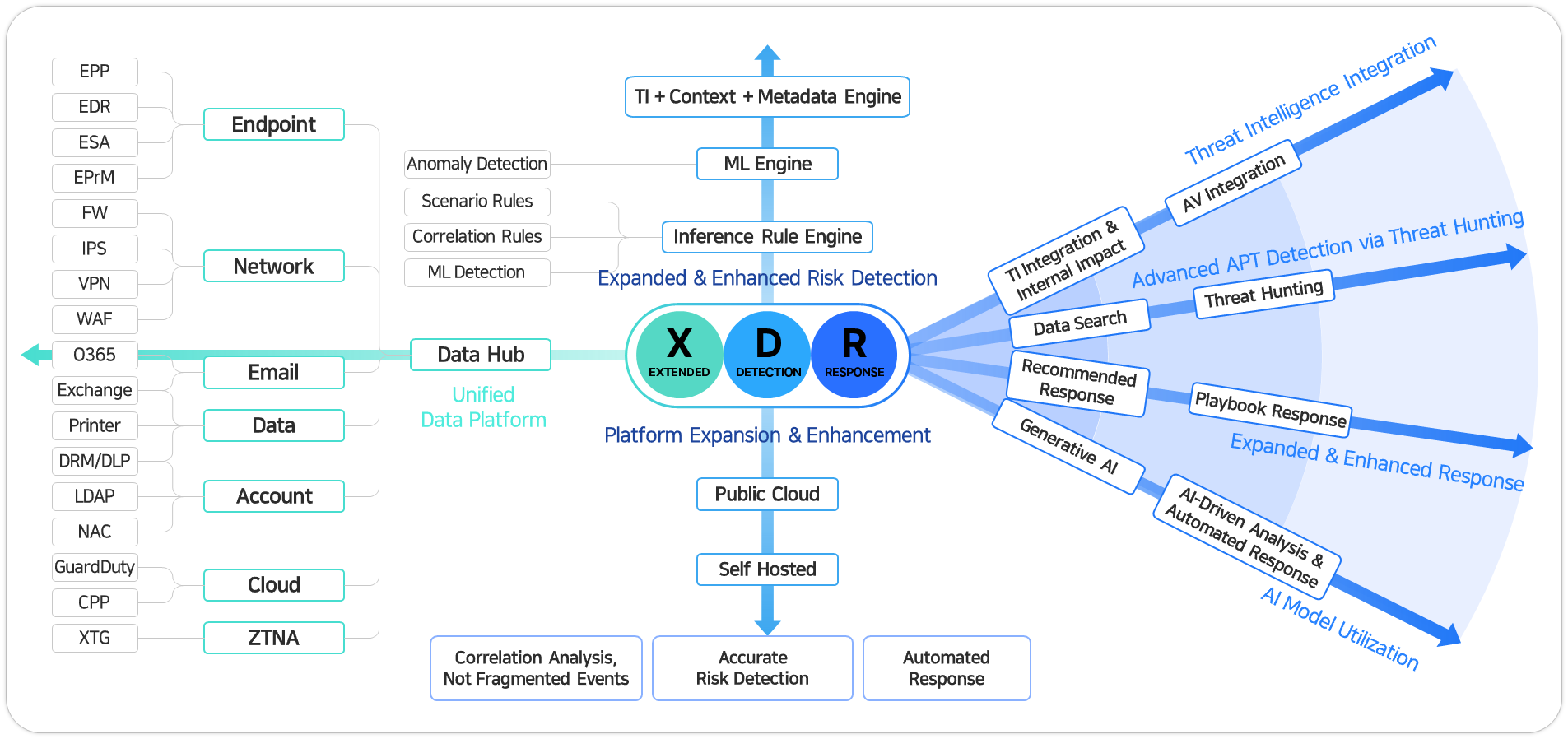
Figure 1. AhnLab XDR Concept
In summary, AhnLab XDR is a platform that maximizes security operations efficiency through AI-based threat detection and automated response mechanisms. Through this, it helps organizations maintain a stable and reliable security posture even in a rapidly changing cyber threat environment.
Completing the Network Security Puzzle with ZTNA
If XDR increases the efficiency of threat detection and response, ZTNA precisely controls network access to fill the gaps in the security framework.
Looking briefly at the background behind the emergence of ZTNA, the traditional model of network security was a firewall-based "perimeter security" system centered on physical boundaries. By building a strong firewall within the enterprise, a certain level of security could be ensured. However, the spread of cloud adoption, the normalization of remote work, and the diversification of connection points such as IoT and mobile devices have now blurred the network perimeter.
The security paradigm designed to respond to these changes is "zero trust," which is based on the principle of "never trust, always verify." The method that actually implements zero trust at the network level is ZTNA. ZTNA thoroughly verifies access attempts regardless of user or device location. It grants only the minimum necessary access privileges, continuously monitors activities that violate security policies, and responds to such activities based on policies.
AhnLab released a new next-generation firewall, "AhnLab XTG," in March 2025 to realize this zero-trust paradigm. AhnLab XTG is the next-generation product following AhnLab TrusGuard, with new features added to support modern network security use cases such as ZTNA and SD-WAN. The ZTNA of AhnLab XTG aims to optimize four of the six core elements of the zero-trust maturity model: "identifier and identification," "device and endpoint," "network," and "system."
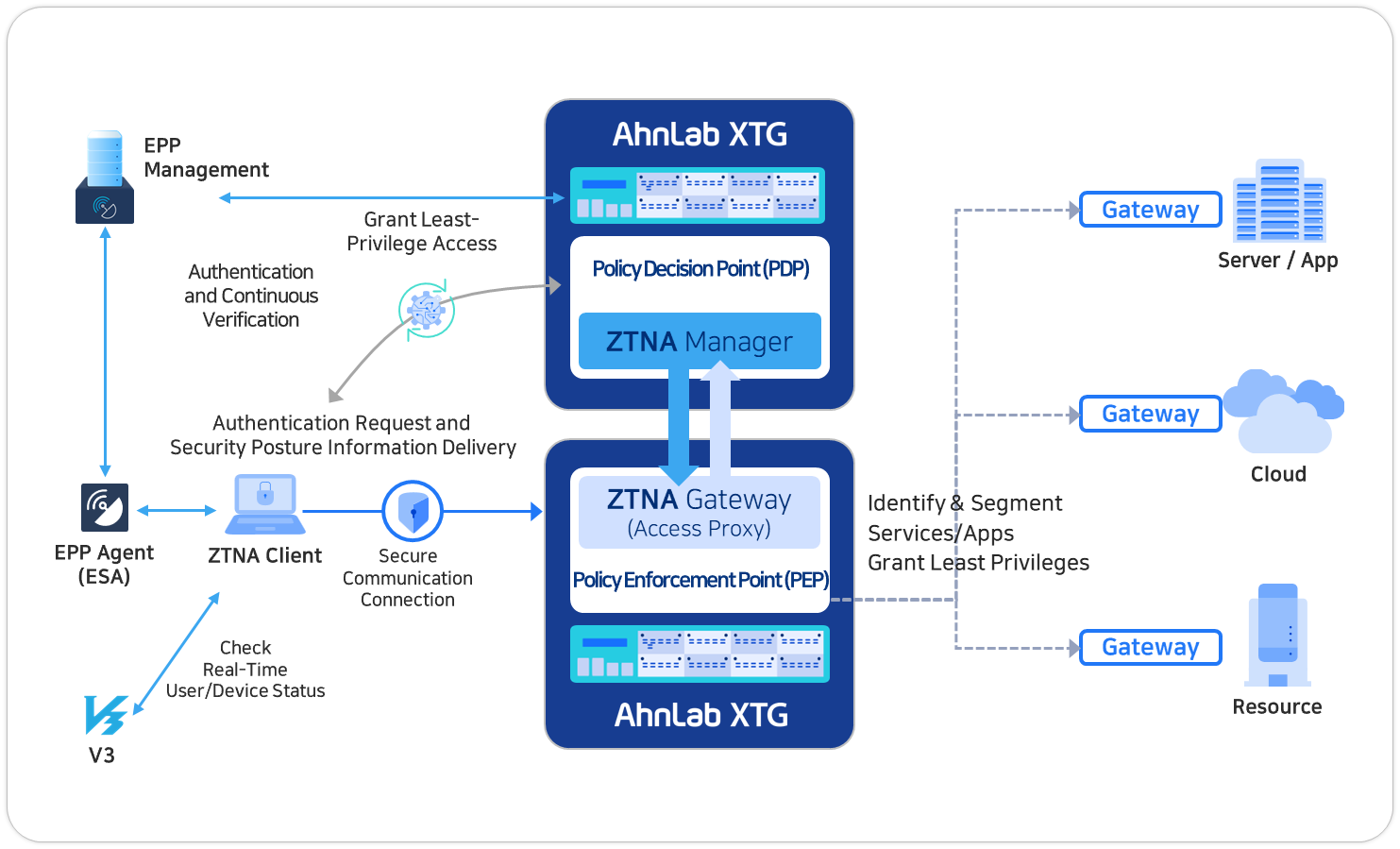
Figure 2. Logical/Physical AhnLab XTG Configuration Diagram
The physical configuration of AhnLab ZTNA is centered around XTG equipment. This equipment performs the roles of Manager (policy decision point, PDP) and Gateway (policy enforcement point, PEP). A ZTNA Client is installed on user endpoints.
Let's assume there are users or devices attempting to access an organization's resources. First, the ZTNA Client installed on the user endpoint communicates with the ZTNA Manager (PDP) to request authentication. Upon receiving the authentication request, the ZTNA Manager determines whether to allow access based on predefined policies. Authorized users can then access resources with the minimum necessary privileges through an encrypted communication channel connected to the ZTNA Gateway. In this process, the ZTNA Gateway acts as the PEP that controls connections and access, while the ZTNA Manager continuously verifies the endpoint state to maintain the organization's security.
In addition, when the AhnLab EPP (EPP Security Assessment, V3) product is integrated with user endpoints, richer and more precise data collection becomes possible. The collected data can be used to define ZTNA policies, further enhancing the efficiency and security of ZTNA.
Synergy Between ZTNA and XDR
Then, what kind of synergy can be achieved by operating an XDR platform in a ZTNA-based network environment? Simply put, strong synergy can be created through a virtuous cycle in which users and devices that have accessed the network through strictly controlled entry points are continuously monitored and proactively addressed as needed. This can be summarized into the following four key points.
(1) Proactive Blocking of Potential Threats
If ZTNA finely controls network access, XDR detects and analyzes threats across the entire system. For example, when suspicious behavior is identified in data collected from the ZTNA Client during the VPN connection process (such as user behavior patterns, device status, or location), XDR dynamically adjusts access privileges in real time, and ZTNA immediately blocks the access session. At this stage, additional threat analysis can be performed through XDR, and identified threat factors can be isolated at the network level. Furthermore, based on the collected data, risk scores for each user and device can be calculated and used as a basis for establishing long-term security measures.
(2) Extension of Zero Trust
ZTNA acts as a gatekeeper that minimizes trust at the user and device level, allowing access only to authorized resources. XDR expands the capabilities of ZTNA, allowing it to assess the trust level of the entire environment. When breach attempts bypassing ZTNA occur, XDR serves as a "watcher" based on its expanded visibility. The combination of the two solutions contributes to building a security framework that can quickly detect and respond even to breach attempts that try to circumvent security.
(3) Strengthening Supply Chain Security
Recently, attacks aimed at securing indirect infiltration paths by targeting relatively weakly secured partners of large enterprises or IT service providers for public institutions have been occurring frequently. A ZTNA-based network environment minimizes access privileges to resources for supply chain partners, while XDR detects anomalies that may occur in the resources they use in real time. By restricting access for external partners and continuously monitoring abnormal signs, supply chain threats can also be effectively defended against.
(4) Enhancing Cyber Resilience
In a ZTNA-based network environment, when an attacker succeeds in initial intrusion and attempts lateral movement to achieve their objectives, internal movement can be blocked, and damage propagation can be limited through the application of micro-segmentation. When XDR is also leveraged, it becomes possible to track the extent of internal damage and quickly identify affected systems. As a result, organizations can rapidly identify threats, minimize damage spread, and establish a response framework that enables swift recovery.
Conclusion
As explained above, the combination of ZTNA and XDR goes beyond enhancing security; it streamlines threat detection and response and can significantly enhance cyber resilience, making it a strategic choice. Security teams can simplify security operations and focus on more meaningful threat hunting activities by leveraging a unified platform, ultimately building a more trustworthy security environment. This, in turn, makes a substantial contribution to ensuring organizational sustainability and strengthening competitiveness.
AhnLab also provides a Managed Extended Detection and Response (MXDR) service, in which experienced security experts analyze threats and propose response strategies. Organizations that struggle with limited security personnel or seek to compensate for gaps in their internal security capabilities can elevate their organization-wide threat detection and response level through AhnLab's MXDR service.
For more detailed information, please visit our AhnLab XDR and AhnLab XTG pages.